Water Spot on the Commerce City Ceiling Below a Bathroom — Find the Source Before It Spreads
A ceiling stain below an upstairs bathroom is a sign water is already moving through your floor assembly. The stain shows where water arrived, not where it started, and finding the real source quickly is what limits the damage.
Leak Emergency? Call (303) 552-3896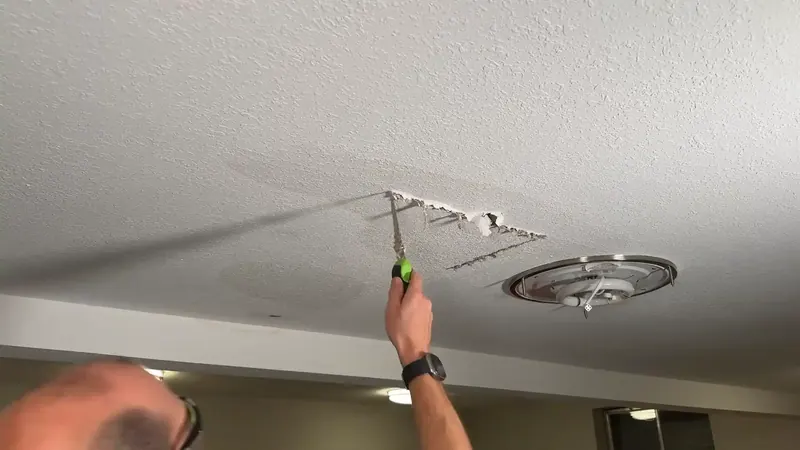
You notice it on the ceiling of a first-floor room, a discoloration directly below an upstairs bathroom. Maybe it started small and grew. Maybe it appeared suddenly after a shower. Either way, a water spot on a ceiling below a bathroom means water has been moving through the floor assembly above. And it has finally saturated through to the ceiling surface where you can see it. In Commerce City's two-story homes and townhomes, particularly in communities like Reunion, Eagle Creek, and River Run, this is a common and important warning sign. The key thing to understand is that the stain marks where the water arrived, not where it came from, and finding the actual source before the damage spreads requires tracing backward.
Why the Stain Is Not Above the Leak
This is the single most important concept for understanding ceiling leaks. When water escapes from a failure in an upstairs bathroom, it does not drop straight down to the ceiling directly below the failure point. Instead, it enters the floor assembly, the space between the upstairs floor and the downstairs ceiling, filled with framing, subfloor, and sometimes insulation. Water follows the path of least resistance through this assembly, running along joists, flowing across the subfloor, and pooling at low points before it finally finds a place to saturate through the ceiling drywall below.
The result is that the visible ceiling stain can be several feet from the actual leak source. A shower pan failure in the corner of an upstairs bathroom might produce a ceiling stain near the center of the room below, because the water traveled along a joist before dripping through. Opening the ceiling at the stain, expecting to find the leak directly above, often reveals nothing but the exit point where the water happened to come through. The source is elsewhere, and finding it requires tracing the water back to its origin.
What Causes Ceiling Leaks Below Bathrooms
Several bathroom failures can produce a ceiling stain below. The most common in Commerce City homes is a shower pan liner failure. Beneath the tile floor of a tiled shower is a waterproof membrane, the pan liner, that is supposed to catch any water that penetrates the tile and grout and direct it to the drain. When this liner fails, water passes through the tile, through the failed liner, and into the floor assembly, eventually reaching the ceiling below. Since grout and tile are not waterproof, a failed pan liner leaks every time the shower is used.
Other sources include a supply valve failure inside the wall behind the tub or shower, which can leak whether or not the fixture is in use; a drain connection failure at the tub or shower, which leaks during active drainage; a toilet wax ring failure, which leaks at the base during flushing; and a tub overflow gasket failure, which leaks when the tub is filled above the overflow port. Each of these has a different signature, and distinguishing them is part of locating the source.
The Timing Test That Narrows the Source
A simple observation narrows down which type of failure you are dealing with. Pay attention to when the ceiling stain grows or when fresh moisture appears. If the moisture correlates with showering, the source is likely the shower, either the pan liner, the drain, or the supply valve. If it correlates with the tub being filled for a bath, the tub overflow gasket or drain is a strong candidate. If it correlates with toilet flushing, the wax ring is implicated. If moisture appears continuously, regardless of fixture use, a pressurized supply line or valve is leaking even when nothing is running.
You can refine this further with a controlled test. For a suspected shower pan failure, plug the shower drain, fill the shower floor with an inch or two of water, mark the level, and wait. If the level drops and moisture appears below, the pan liner is breached. This kind of targeted test, isolating one fixture and one failure mode at a time, helps pinpoint the source before any ceiling or wall is opened.
How Thermal Imaging Traces the Source
The most efficient way to trace a ceiling leak back to its source is thermal imaging. After running the suspected fixture, a thermal camera scans the ceiling below. The camera detects the temperature difference between the wet, water-affected areas of the ceiling and the surrounding dry material. This reveals not just where the water has reached, but the pattern of moisture migration through the floor assembly, which often shows a gradient leading back toward the source.
By mapping the full extent of the moisture and the direction it is traveling, thermal imaging guides the investigation to the area of the bathroom above where the leak originates. Combined with the timing observations and targeted fixture tests, this allows the source to be identified and the access opened in the right place, rather than opening the ceiling at the stain and finding only the exit point. For Commerce City's two-story homes, where opening a finished ceiling is disruptive, this precision matters.
Why Acting Quickly Matters
A ceiling stain below a bathroom is not just a cosmetic problem. By the time water has saturated through to the visible ceiling surface, the floor assembly above has been wet for some time, often weeks for a slow leak. Wet framing and subfloor can develop mold, and prolonged moisture can degrade the structural wood. The longer the leak continues, the more the moisture spreads through the assembly and the more extensive the eventual remediation.
This is especially true for shower pan liner failures, which leak with every shower and tend to worsen over time as the breach in the liner grows. What starts as a faint ceiling stain can progress to sagging drywall, spreading mold, and damaged framing if left unaddressed. Finding and fixing the source promptly limits the damage to the smallest possible area.
The Shared-Wall and Multi-Unit Consideration
In Commerce City's townhome communities like Eagle Creek and River Run, ceiling leaks carry an additional consideration. When units share walls and floors, a leak originating in one unit can sometimes surface in an adjacent unit, and establishing which unit the source is in matters for repair responsibility and insurance. Thermal imaging that identifies the source location can clarify which side of a shared wall or which unit the leak belongs to, which is important when the homeowner association or multiple homeowners are involved.
A water spot on a ceiling below a bathroom is a signal to act, not to wait and watch. The water is already moving through your floor assembly, and the source is somewhere in the bathroom above, though not necessarily directly over the stain. Tracing it back with timing observations, targeted tests, and thermal imaging finds the real source and limits the damage. If you have a ceiling stain below a bathroom in your Commerce City home, call (303) 552-3896 to have the source located before it spreads.
Have a Leak in Commerce City Right Now?
Find the leak before the damage spreads. Commerce City and Adams County response, any hour.
Call 24/7: (303) 552-3896Frequently Asked Questions
Why is the ceiling stain not directly below the leak in my Commerce City home?
Water from an upstairs bathroom failure enters the floor assembly and follows the path of least resistance, running along joists and across the subfloor before saturating through the ceiling. The visible stain marks where the water exited, which can be several feet from the actual source. This is why opening the ceiling at the stain often reveals only the exit point, not the leak.
What usually causes a ceiling stain below a Commerce City bathroom?
The most common cause is a shower pan liner failure, where water passes through the tile and a failed waterproof membrane into the floor assembly. Other sources include a supply valve failure in the wall, a tub or shower drain connection failure, a toilet wax ring failure, and a tub overflow gasket failure. Each leaks under different conditions, which helps identify the source.
How is the source of a Commerce City ceiling leak found without opening the ceiling?
Thermal imaging scans the ceiling after running the suspected fixture, mapping the moisture extent and the direction it traveled through the floor assembly, which traces back toward the source. Combined with timing observations, when moisture appears relative to fixture use, and targeted tests like a shower pan flood test, the source is identified so the access opens in the right place.
Related Services
- Ceiling Leak Detection & Repair
- Bathroom Leak Detection & Repair
- Shower Pan Leak Detection & Repair
- Thermal Imaging Leak Detection
- Shower Leak Detection & Repair
- Wall Leak Detection & Repair
Service Areas
Commerce City Leak Detection, 24/7
Adams County licensed. Non-invasive detection. No forms.
(303) 552-3896