Commerce City Homes Over 20 Years Old: Why Pinhole Copper Leaks Are Almost Inevitable
If your Commerce City home was built before 2005 with copper supply lines, the question is not whether you will get a pinhole leak, but when. Here is the chemistry behind it and what to do when the first one appears.
Leak Emergency? Call (303) 552-3896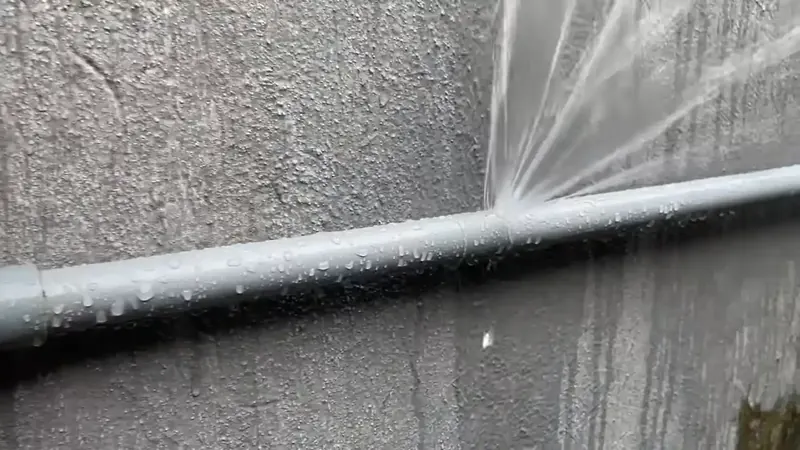
There is a specific reason pinhole leaks cluster in Commerce City's older copper-supply homes, and it is not bad luck or poor workmanship. It is water chemistry combined with time. For decades, the South Adams County Water and Sanitation District delivered water at roughly 21 grains per gallon hardness, placing Commerce City's supply in the very-hard classification at the upper range for Front Range Colorado communities. That water spent 40 to 60 years in contact with the type-M copper supply lines installed in homes built from the 1960s through the early 2000s. The result is a corrosion process that has been quietly thinning those pipe walls from the inside the entire time, and it is now reaching the point of failure across the city's older housing stock.
The Chemistry of Copper Pitting Corrosion
Copper pipe does not corrode uniformly. It develops pits, small localized points where the protective cupric oxide layer that normally shields the copper has thinned or been disrupted. At each pit, dissolved oxygen in the water reacts with the exposed copper surface, deepening the pit. In water with high dissolved mineral content, the chemistry gets worse. Scale deposits accumulate around the edges of each developing pit, concentrating the corrosive reaction at the base of the pit rather than allowing it to disperse across the broader pipe surface. The pit deepens faster than it would in soft water, drilling steadily toward the outer wall of the pipe.
At some threshold of remaining wall thickness, the pit perforates completely. Water under residential supply pressure of 40 to 80 PSI finds the perforation and begins to escape. The result is a pinhole leak: a 1 to 3 millimeter perforation losing water at 0.1 to 0.3 gallons per hour. That flow rate is slow. It is slow enough that the water disappears into the wall cavity, the floor assembly, or the slab sub-base for weeks before any visible symptom appears at the surface.
Commerce City's pre-2021 water at 21 grains per gallon accelerated every stage of this process. The mineral content that defined the city's hard water is the same mineral content that concentrated the corrosive chemistry at the pit bases. Homes that received this water for 40 or 50 years accumulated pit damage that homes in soft-water markets simply do not experience on the same timeline.
What the 2021 Softening Project Did and Did Not Change
In 2021, SACWSD completed a centralized softening project that dropped the water hardness from roughly 21 grains per gallon to about 7 grains per gallon, a 67 percent reduction. This is a genuine improvement, and it matters for new copper installations and for the long-term outlook of the system. Water at 7 grains per gallon is far less aggressive toward copper than water at 21 grains per gallon.
But the softening project did not, and could not, reverse the damage already accumulated in existing pipe. The pits that formed over the prior decades are still there. The thinned wall sections are still thin. A copper supply line that spent 45 years in contact with 21-gpg water carries that history in its pipe walls regardless of how soft the water flowing through it is today. The softening project changed the future; it did not change the past. For Commerce City homes built before 2000 with original copper, the relevant variable is the accumulated pit damage, not the current water chemistry.
Why the First Pinhole Predicts the Next
This is the part that surprises most Commerce City homeowners. When the first pinhole leak appears in an older copper supply system, it is tempting to treat it as an isolated event: one bad spot in one pipe, repaired and forgotten. But the copper that has not yet failed is not in better condition than the copper that just did. It was installed the same year, by the same plumber, using the same copper stock, and it was exposed to the same 21-gpg water for the same number of decades. The entire supply system is at the same corrosion stage.
The pipe that failed first failed because of a slightly thinner starting wall, a slightly more aggressive local water flow pattern, or a slightly earlier pit initiation. The difference between the first pipe to fail and the next is measured in months, not years. In practice, a second pinhole leak on the same supply system typically appears within 6 to 18 months of the first. The third follows. This is the serial-failure pattern that characterizes aging copper supply in Commerce City's tract neighborhoods like Fairfax, Rose Hill, and North Beach.
The Math on Spot Repair Versus Repipe
Each pinhole spot repair involves locating the failure, opening an access cut in the wall or core-drilling the slab, cutting out the failed section, installing a coupling, and patching the opening. For a single isolated failure in otherwise sound pipe, this is the right approach. But when the pattern is established, the economics shift.
Consider a 1975 Commerce City tract home with original copper throughout. The first pinhole is repaired. Eight months later, a second appears on the same hot-water circuit and is repaired. Fourteen months after that, a third appears on the cold-water circuit. Each repair involves the access cut, the pipe work, and the drywall patching. Three spot repairs over two years, with their combined access, repair, and restoration labor, frequently cost more than a single whole-house repipe would have cost at the time of the first failure. And the homeowner has lived through three separate episodes of wall opening, water shutoff, and repair disruption.
A supply survey after the first pinhole is the tool that informs this decision. The survey assesses how many other circuits show similar corrosion stage indicators. For a Commerce City home with original copper built before 1980, the survey answer is usually that more than one circuit is at risk. That information lets the homeowner make the repair-versus-repipe decision on the basis of the actual pipe condition rather than discovering the pattern one expensive repair at a time.
What a Whole-House Repipe Involves
A whole-house repipe replaces all supply distribution lines from the main shutoff to the individual fixture connections. The drain stack is not included unless it is also failing. The standard replacement material is PEX cross-linked polyethylene, which handles Commerce City's post-2021 water at 7 grains per gallon without the mineral deposit accumulation that affected the original copper, and which flexes to absorb the Adams County clay soil movement that stresses rigid pipe.
For a standard 3-bedroom, 2-bathroom Commerce City home, the pipe installation phase typically takes 1 to 2 days, followed by 1 to 2 days for drywall patching and restoration. The PEX is run from a manifold installed at the water heater or in the utility room, with individual circuits branching to each fixture group. The manifold configuration provides shutoff isolation at a central point, which simplifies future fixture maintenance.
How to Detect the First Pinhole Before the Wall Gets Wet
The most reliable early indicator of a pinhole leak in a Commerce City home is SACWSD meter movement during a no-use period. Close every fixture and appliance in the house. Locate the SACWSD potable meter in the curb box in the parkway. Watch the flow indicator, the small triangle or dial on the meter face, for 60 to 90 seconds. Any movement confirms active supply loss somewhere in the system, even when no wet spot has appeared.
Secondary indicators include an unexplained SACWSD bill increase, soft or discolored drywall at supply-line wall locations, and in crawlspace homes, rust staining on concrete or soil below copper pipe runs. When any of these appear, electronic leak detection locates the specific failure. Electronic amplification detects the low-flow pinhole signal that standard acoustic equipment misses, and electronic correlation pinpoints the failure to within 12 to 18 inches for a targeted access cut.
For Commerce City homeowners with copper-supply homes over 20 years old, the practical takeaway is straightforward: the first pinhole is not a question of if, but when. Recognizing the pattern early, confirming the supply condition with a survey, and making the repair-versus-repipe decision on the basis of actual pipe condition is what separates a manageable plumbing transition from a multi-year sequence of expensive surprises. If you have noticed a bill increase or a soft spot in a wall, or if you have already had one pinhole repaired and want to understand your system's overall condition, call (303) 552-3896 for a supply assessment.
Have a Leak in Commerce City Right Now?
Leak detection and repair across Commerce City, any time. Adams County licensed, no forms.
Call 24/7: (303) 552-3896Frequently Asked Questions
How long do copper pipes last in Commerce City homes?
Type-M copper supply in Commerce City homes typically begins showing pinhole failures at 40 to 60 years of age, accelerated by the pre-2021 SACWSD water hardness of 21 grains per gallon. Homes built in the 1960s through 1980s are now in or entering this failure window. The 2021 centralized softening project reduced hardness to about 7 grains per gallon, which benefits new pipe but does not reverse accumulated corrosion in existing copper.
Is one pinhole leak a sign I need to repipe my whole Commerce City house?
Not necessarily on the first failure, but a supply survey after the first pinhole is strongly recommended. The copper that has not failed is at the same corrosion stage as the pipe that did, since it was installed the same year and exposed to the same water for the same duration. A second failure within 18 months indicates whole-house repipe with PEX is more economical than continued spot repairs.
Can I prevent pinhole leaks in my Commerce City copper pipes?
The accumulated pit corrosion from decades of pre-2021 hard water cannot be reversed. The 2021 softening project slows future corrosion in any remaining copper, but it does not restore thinned pipe walls. The most practical preventive step is early detection through periodic SACWSD meter testing, which catches active leaks before they damage walls, and a supply survey to understand the overall condition of an aging copper system.
Related Services
- Pinhole Leak Detection & Repair
- Copper Pipe Leak Detection & Repair
- Whole-House Repipe Service
- Electronic Leak Detection
- Wall Leak Detection & Repair
- Non-Invasive Leak Detection
Service Areas
Commerce City Leak Detection, 24/7
Adams County licensed. Non-invasive detection. No forms.
(303) 552-3896